Olivia is a PhD student in Urban and Regional Planning at UB’s School of Architecture and Planning and a Presidential Fellow. Originally from Ghana, she earned her Master’s degree in Urban Planning from Minnesota State University, a Bachelor’s degree in Human Settlement Planning from Kwame Nkrumah University of Science and Technology, and a Graduate Certificate in GIS. Before coming to UB, she worked as the Community Development Coordinator for the City of Eagle Lake, Minnesota. Olivia is passionate about urban food systems and studies how land use policies can restrict urban agriculture. She also explores the ways food insecurity creates cognitive overload, influences decision-making, and leads to tunneling. At UB’s Food Lab, she is researching how food insecurity affects cognitive functioning on Buffalo’s East Side. In her spare time, she enjoys connecting with her family in Ghana and going to the gym.
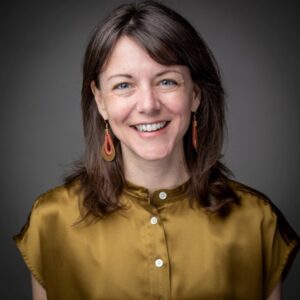
Jane Dai (she/her) draws from multiple disciplines to understand how food systems—shaped by policy, systems, and environments—structure the environments where communities pursue health and well-being. She strives to approach research with a storytelling lens by applying mixed methods to an expansive definition of “data” that includes numbers, narratives, maps, and media. Her work and practice at the intersection of public health, urban planning, and public policy aims to leverage her role as a researcher to translate data and evaluation into equitable, affirming, and liberative strategies for community flourishing.
Jane’s research has focused on exploring cascading effects of racial capitalism in food systems and population health systems. She is particularly interested in how gentrification—alongside other processes related to uneven community development—influences where, when, and how people access food in urban and suburban contexts. Other longtime interests include commercial determinants of health, food decision-making contexts, and big data for public health nutrition. As a full-time human, Jane also enjoys spending her time outside or doing “analog” activities. You can find her dog-spotting on runs, drinking tea and reading, tinkering with sourdough pastries, puzzling, or convincing the neighborhood cat to accept chin scritches.
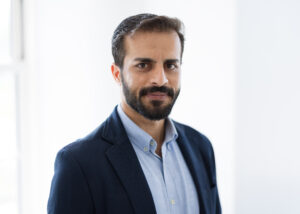
Mohsin is a Fulbright scholar pursuing a doctorate in urban and regional planning at the University at Buffalo. An international scholar from Pakistan, Mohsin began his doctoral work in the US in 2022 and joined the UB Food Lab in 2025. His research interests include climate change and mitigation, and the disparate impact of urban heat on varied groups of people.
At the Food Lab, Mohsin leads spatial and quantitative data management and analyses across multiple projects, including the national Data Justice for Food Justice project as well as more local projects focused on documenting disparities in the retail food environment in Erie County. Mohsin brings considerable training and work experience to his work in the Food Lab. Mohsin comes to the UB Food Lab with prior graduate degree in remote sensing and geographic information systems and work experience as a GIS professional with the World Wide Fund for Nature (WWF) in Pakistan. In Pakistan he also taught GIS-related courses to undergraduate and graduate classes at a public university.
In his leisure time, Mohsin enjoys playing squash, badminton, and chess. He also likes hiking, kayaking, cycling, and reading.
Molly Riordan is a food systems planning practitioner who pursues equitable regional approaches for building environmentally and socially responsible supply chains. For the last decade, she has explored how large demand centers of food, like cities and anchor institutions, can be levers for food systems transformation.
Molly is the co-author of The Promise of Urban Agriculture: a National Study of Commercial Farming in Urban Areas (2019), a groundbreaking report that now includes a professional development course for planners offered through the Cornell Small Farms Program. She is the current chair of the American Planning Association Food Systems Division, and co-founder of the nonprofit Philly Cooks for Philly, an initiative to build a central kitchen for Philadelphia food programs. Most recently, Molly has also acted as program director at the Center for Good Food Purchasing, which supports large institutions to purchase more values-based foods.
A Western New York native, Molly is returning to Buffalo to pursue a PhD in Urban and Regional Planning, with an interest in resident-led resource and data management for climate change resilience. She earned her master’s in regional planning at Cornell University, and her bachelor’s degree at Ithaca College.
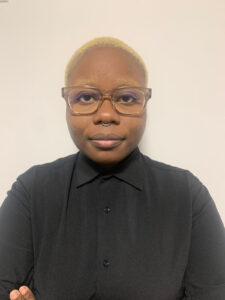
Sid Clarke is graduate of the Master of Urban Planning program at the University at Buffalo. Born and raised in Brooklyn, NY, they were first introduced to urban agriculture in high school during an internship with the City Parks Foundation, where they spent eight months working in a community garden. They graduated with a Bachelor’s in Anthropology from the City University of New York- Brooklyn College, where they conducted their senior ethnographic research project on food access inequities and environmental racism in predominantly Black communities in New York City and Washington DC. Their interests within planning include food systems, climate justice, and sustainable urban design. They hope to use green urban design to advocate for sustainable infrastructure that supports the health and autonomy of people and the planet, and to endorse community focused equitable urban agriculture and nontraditional food retail to address the systemic inequities that communities of color face in the food system. In their free time, Sid enjoys hiking, pottery and crocheting to unwind.
Justin Kleppel graduated with a degree in public health from the University at Buffalo. Originally from New York City, Justin has a deep passion for cities and the health outcomes of those who live in them. Prior to his Master’s, Justin completed his undergraduate degree in Public Health at the University at Buffalo. He aspires to fix food insecurity and health inequalities at the root and believes planning is a tool to accomplish this. Outside of the Food Lab, Justin enjoys coffee and sports. He is also an athlete competing internationally in track & field, and bobsled.
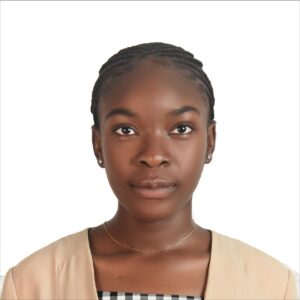 Faithwin Gbadamos is a PhD student in the Department of Geography. Her research is centered on the nexus of sustainability, health, and development. Her research seeks to answer questions about environmental degradation linked to food security, livelihood impacts, and adaptation strategies. She uses the power of geospatial analysis to gain insights into the relationship between spatial dynamics and social factors. At the Food lab, Faithwin is responsible for tasks involving geographic information.
Prior to starting her PhD, Faithwin explored diverse sectors, including energy and telecommunications, providing her with firsthand insights into these sectors and the critical need for sustainable practices. This experience solidified her unwavering commitment to environmental sustainability and health. Faithwin graduated from the University of Ibadan, Nigeria with a bachelor’s degree in Geography.
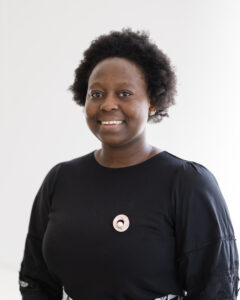
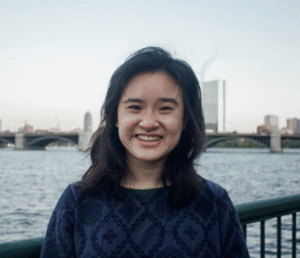

 Alissa Ujie Diamond is an assistant professor in the Department of Urban and Regional Planning at the University at Buffalo, SUNY. Diamond’s work focuses on histories of spatialized inequity and action-research as a basis for systems change in the contemporary world. As an interdisciplinary scholar, she draws on an early career in applied architectural and landscape design as well as scholarly frameworks from environmental history, geography, plant humanities, urban planning, and ethnic studies.
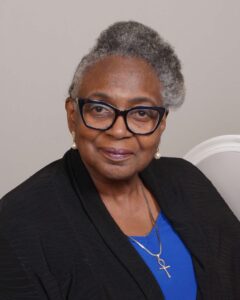 Ms. Della Miller is the 2024 Community Advisor for Research that is Equitable (CARE) Fellow in the UB Food Lab, where she provides guidance and advice on all Buffalo-focused community-related research projects. She is a passionate advocate and experienced consultant in multiple spheres, including community health, education and generational wealth for underserved and low-income communities. A distinguished leader in the field of food equity, Ms. Miller has founded or co-founded multiple food-related initiatives in Buffalo, NY, including St. Augustine’s Food Co-Op and Buffalo Federation of Neighborhood Centers Food Co-Op. As a trained food service expert, she has supported the planning, design, and execution of commercial kitchens with a view toward health and safety. Additionally, she has lent her expertise as a member of the Black Farmers United – NYS, and Buffalo Black Chamber of Commerce, and as a board member of the Clean Air Coalition. She currently serves on the board of Buffalo Freedom Gardens, Inc., a not-for-profit organization committed to helping people grow their own food to support their destinies, and provide for their families while building a loving, healing community that is thriving, healthy and well.
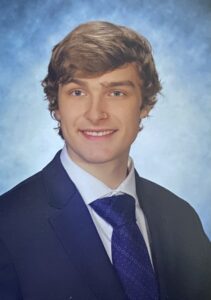 Matthew Tilly